
The New Termination Shock
From energy shocks to geopolitical conflict, recent events expose the dangerous assumptions behind SAI

There is a growing tendency in parts of the climate debate to treat Stratospheric Aerosol Injection (SAI) as though it were simply another engineering challenge waiting to be scaled. The logic often sounds deceptively straightforward. Aircraft release reflective particles into the stratosphere, a portion of sunlight is scattered back into space, and global temperatures are temporarily reduced. On paper, it can appear almost seductively simple.
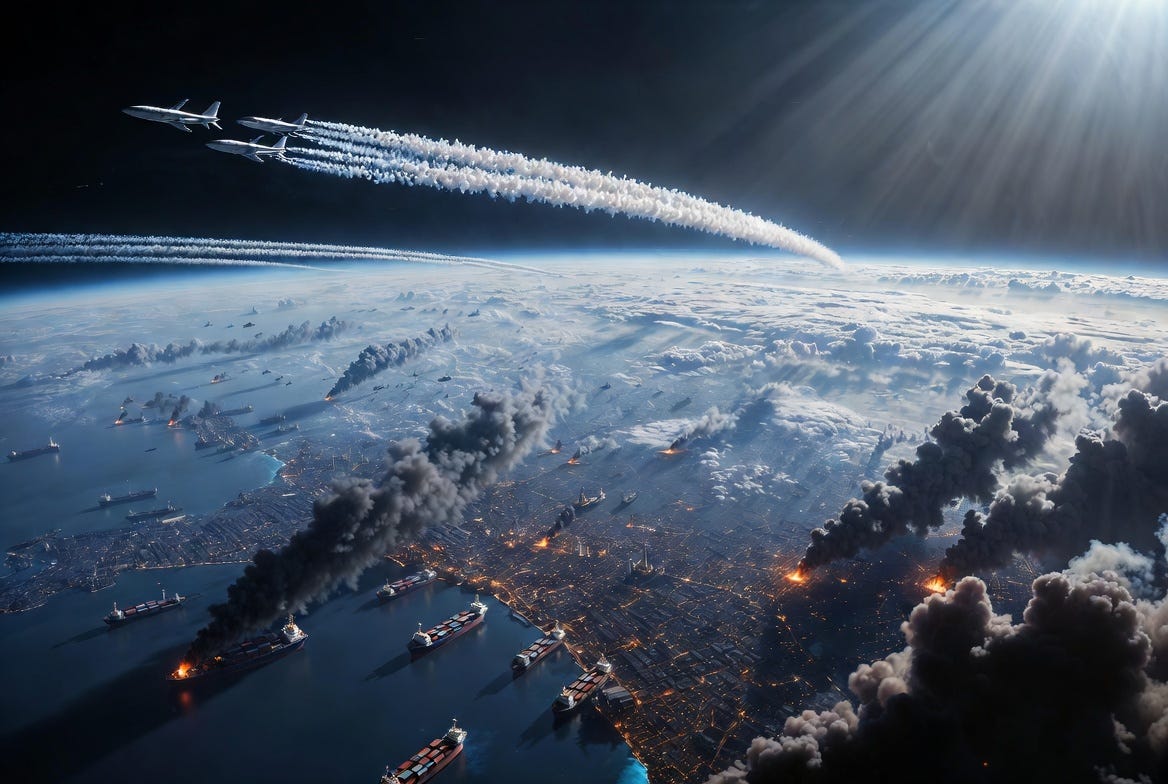
The reality is far more troubling.
What is often overlooked in these discussions is the sheer permanence of the commitment that such a system would require once deployed at scale. SAI is not a one-off intervention. It is not a project that can simply pause for a few years during political instability, economic crisis, or geopolitical conflict. It would demand continuous operation on a planetary scale, year after year, decade after decade.
That means constant industrial activity. Constant aircraft production. Constant fuel supply chains. Constant take-offs. Constant coordination between nations that increasingly struggle to cooperate even on far smaller issues. It would effectively require humanity to maintain a permanent atmospheric engineering programme without interruption.
Recent events in the Middle East should give us pause.
We have once again seen how rapidly geopolitical instability can disrupt energy markets, shipping routes, industrial systems, and international logistics. Entire sectors of the global economy remain deeply interconnected and vulnerable to shocks that are often impossible to predict in advance. The sight of cargo ships stranded or rerouted, fuel prices surging, supply chains slowing, and political tensions spilling across borders is a reminder of just how fragile supposedly stable global systems can become.
Critically, recent events have also demonstrated how vulnerable aviation fuel supplies are to geopolitical disruption. Modern jet aircraft depend overwhelmingly on kerosene-based jet fuel systems, and any major interruption to global fuel production, refining, or transport networks could rapidly impact aviation capacity itself.
Now imagine applying that fragility to a planetary cooling system that cannot safely stop.
This is where the issue of termination shock becomes impossible to ignore. If SAI were masking a significant degree of warming and the programme was then interrupted suddenly, whether through economic collapse, war, political fragmentation, fuel shortages, or global instability, temperatures could rebound rapidly. The warming that had been artificially suppressed would return in a compressed period of time.
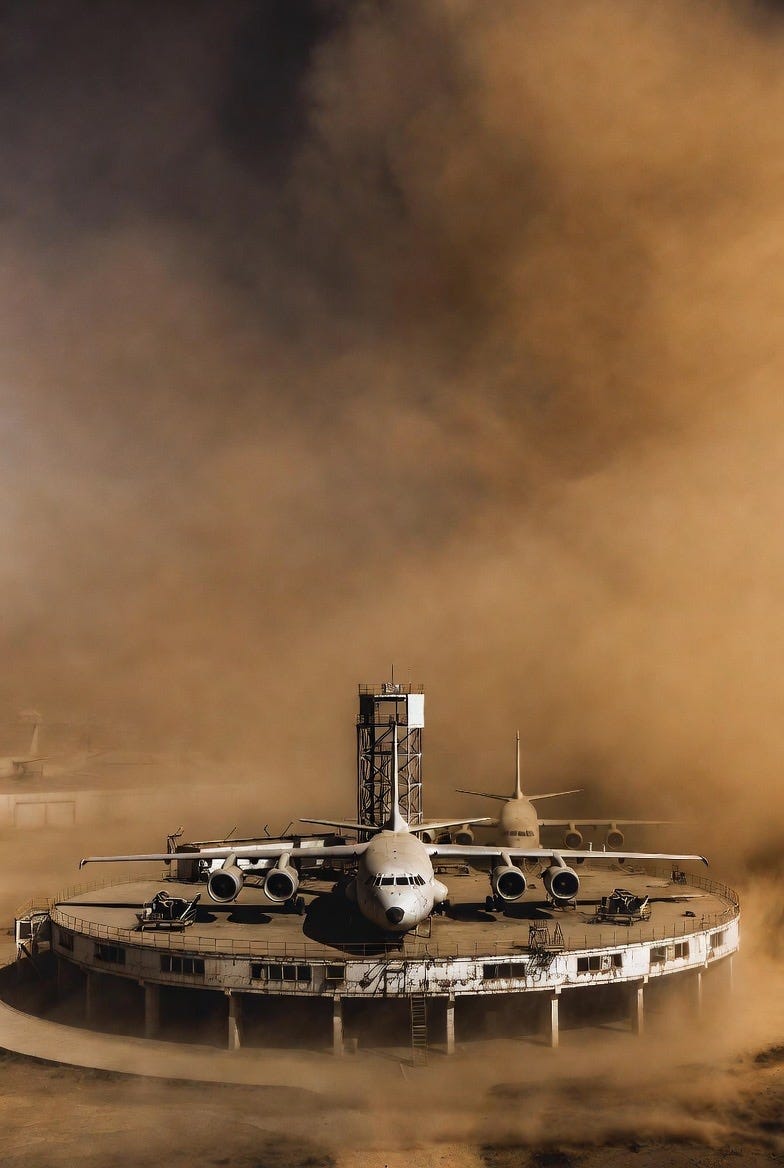
The consequences of such a shock could be devastating for ecosystems, agriculture, infrastructure, and human health. Species and food systems already struggling to adapt to gradual warming would instead face an abrupt climatic acceleration.
This is one of the central reasons why I have never viewed SAI as a desirable long-term pathway, despite its theoretical cooling potential. The challenge is not simply whether it can cool the planet temporarily. The challenge is whether humanity can realistically guarantee uninterrupted operation for generations in an increasingly unstable and fragmented world.
Even securing the initial political consensus would be extraordinarily difficult. Yet political agreement is only the beginning. The larger issue is maintaining continuity through future crises that we cannot yet predict.
There are also profound democratic questions. Who controls the thermostat of the Earth? Which countries decide the acceptable global temperature? Who bears responsibility if rainfall patterns shift or agricultural systems are disrupted elsewhere? These questions become even more concerning in a century likely to be defined by geopolitical tension and resource competition.
For these reasons, I continue to believe that surface-based approaches deserve far greater attention.
Unlike atmospheric injection systems, surface-based cooling techniques can be deployed in a distributed and decentralised way. They can be owned locally, adapted regionally, and implemented incrementally. They also provide dual benefits. They can reduce urban heat and the urban heat island effect while simultaneously helping agriculture, water conservation, and public health.
In a warming world, adaptation and mitigation increasingly overlap.
Protecting water resources alone will become one of the defining challenges of this century. One only has to look at the worsening conditions across parts of the western and midwestern United States, where reservoirs and river systems are under enormous strain. The fact that even the Hoover Dam has faced operational disruption due to declining water levels would once have seemed extraordinary.
Suppressing evaporation, reducing surface temperatures, protecting agricultural productivity, and improving human thermal survivability are not secondary issues. They are central to maintaining stability for a global population of more than eight billion people.
The appeal of SAI is understandable. Faced with escalating heat extremes and political paralysis on emissions reductions, many are understandably searching for emergency measures. But emergency measures that themselves depend on flawless long-term industrial continuity may introduce an entirely new category of systemic risk.
The climate crisis is already forcing humanity to confront uncomfortable realities. One of those realities may be that resilience matters just as much as theoretical effectiveness. A cooling system that depends on uninterrupted global industrial stability in an era of growing instability may ultimately prove far more dangerous than many are willing to admit.
yeah, population is the proverbial third rail, but nonetheless, I do try to speak to the ability of accomplishing the mission responsibly. The math works within 40 years, and a government mandate is not required. In fact, more the opposite. Governments adapting pro natalist policies are infuriating. I realize I'm talking about an extended period of economic contraction [a 40 year recession] but that's I think better than the alternative we're heading for.
You are also right about how a comparatively few of us are responsible for the majority of the problem and the inequity of that equation. But the rest of the world sees how we live and they're catching up quickly. Of, course the irony is that per capita standard of living is now, after so much progress, in decline. We have to scale back...problematic...to be certain. Impossible... not at all.
Necessary...absolutely beyond a doubt.
the first priority must be to reduce human population. Without a reduction by at least half, all the energy transition and carbon sequestration won’t be enough to make a difference.
Your concerns about SAI, who decides how and how much and who pays for the ramifications are all serious issues, but this is addressing a symptom of the real issue.
There’s simply too many of us using too much stuff too quickly. If we want to solve problems, we need to make sure that this is at least a concurrent priority along with combatting atmospheric heating.
If any difference is going to be made, it will involve getting human population back down below 4 billion within the next 40 years or so.