
Cooling the planet requires much more than planting trees
Forests and solar power matter, but neither alone addresses the Earth’s energy imbalance driving global warming

There is a comforting simplicity to many of the solutions now put forward in response to climate change. Plant more trees, build more solar panels, decarbonise the energy system. Each of these has a role to play and none should be dismissed. Yet taken together, they often create the impression that the problem is being solved through a set of straightforward substitutions, as if one form of energy or land use can simply be swapped for another without consequence. The reality is more complex. Climate change is not only a question of carbon, nor only a question of energy supply. It is fundamentally a question of how energy enters, moves through and ultimately leaves the Earth system.
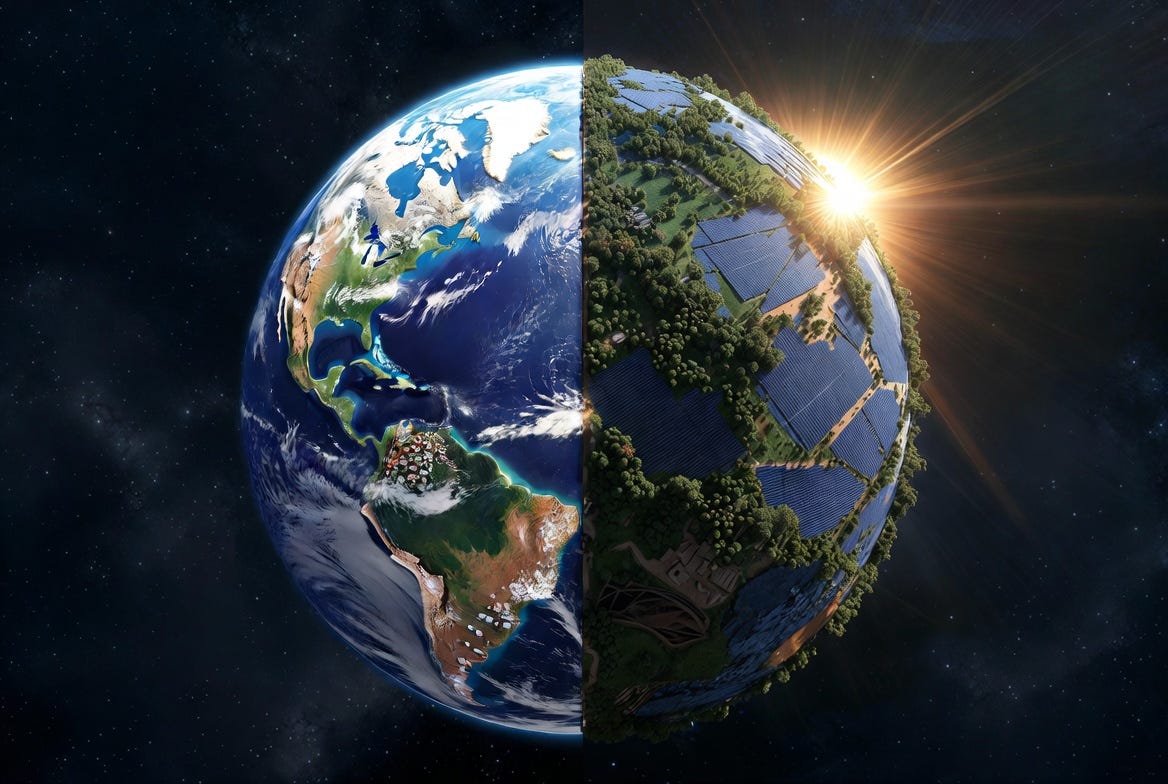
At the most basic level, the planet is warming because more energy is arriving from the Sun than is escaping back into space. This imbalance is small in percentage terms but enormous in absolute scale. It is the accumulation of this excess energy that warms the oceans, drives more extreme weather and increases the risk of crossing thresholds beyond which change becomes difficult to reverse. Any serious response must therefore be judged not only by how it reduces emissions, but by how it affects this underlying energy balance.
Forests are often presented as a central part of the solution. They are essential for biodiversity, water cycles, soil health and local climate regulation. Protecting existing forests is one of the most important environmental priorities we face. However, the idea that simply expanding global tree cover will significantly cool the planet is not supported by a full accounting of the physics involved. Forests are darker than many of the surfaces they replace. When grasslands, drylands, or snow-covered areas are converted to forest, the surface reflectivity decreases, and more solar energy is absorbed. While forests can reduce local air temperatures through shade and evapotranspiration, they also increase atmospheric moisture, which contributes to the greenhouse effect, and they alter cloud behaviour in ways that are not always cooling. What is experienced locally as a cooler environment does not necessarily translate into a reduction in the total energy held within the system.
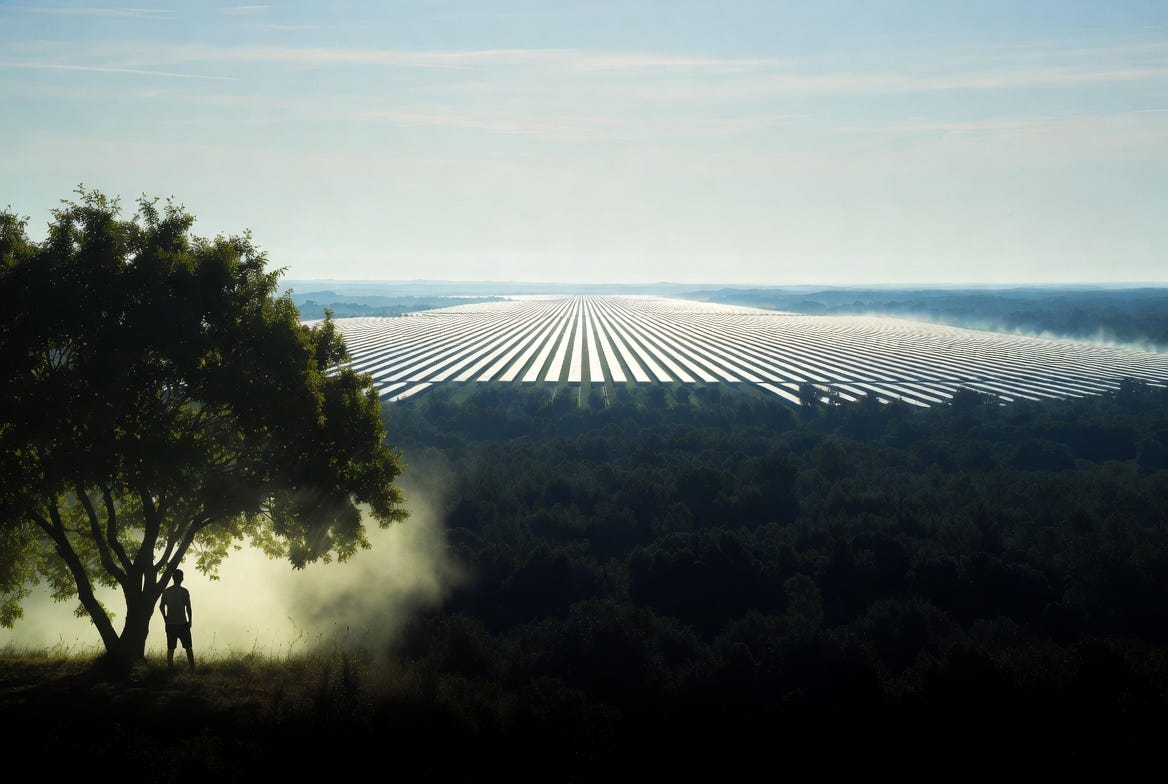
A similar tension exists in the rapid expansion of solar power. There is no credible path to reducing emissions without a major increase in renewable energy, and solar generation is a critical part of that transition. However, it is often assumed that deploying solar panels is inherently climate-neutral at the surface. In reality, most photovoltaic panels are dark and highly absorptive. When installed across large areas, particularly in naturally reflective environments, they reduce land albedo and increase the amount of solar energy absorbed. This does not negate their value in displacing fossil fuels, but it does mean that their impact on the Earth’s energy balance is more nuanced than is commonly acknowledged.
There is also a broader issue in how the energy transition itself is understood. Much of the current expansion of renewable energy is additive rather than substitutive. New solar and wind capacity is being built, but global energy demand continues to rise, and fossil fuel use has not declined at the pace required. In many cases, renewable energy is being layered onto an existing fossil-based system rather than replacing it outright. At the same time, modern civilisation remains deeply dependent on oil, gas and coal not only for energy, but for the production of materials, chemicals, fertilisers and a vast range of everyday products. Plastics, pharmaceuticals, transport systems, industrial processes and global supply chains are all tied, directly or indirectly, to fossil inputs. Transitioning away from this system is not simply a matter of generating more electricity. It requires a fundamental restructuring of how goods are produced and consumed.
This creates a difficult but important reality. Expanding renewable energy infrastructure is necessary, but on its own, it does not guarantee a reduction in total system emissions or energy imbalance. If overall energy use continues to grow and fossil fuels remain embedded in the wider economy, the transition risks becoming a process of addition rather than replacement. In that context, even well-intentioned solutions can fall short of what is physically required.
What is largely missing from this discussion is a sustained focus on the other side of the energy equation: how much incoming solar radiation is reflected back into space before it can be absorbed. Increasing the reflectivity of the Earth’s surface offers a direct and immediate way of reducing the net energy entering the system. This is not a speculative idea but a straightforward consequence of basic radiative physics. Yet compared with the scale of investment in energy generation and carbon management, it receives remarkably little attention.
There are many potential ways to increase surface reflectivity, particularly in built environments and in certain landscapes where ecological trade-offs are minimal. Light-coloured materials, reflective surfaces, and simple structural interventions can reduce absorption and return more energy to the space. These approaches are often low-cost, rapidly deployable and technically simple. They do not replace the need for emissions reduction or ecosystem protection, but they address a different and equally important part of the problem.
The contrast between high- and low-technology responses is instructive. Modern climate strategies tend to favour complex, capital-intensive systems that require long development times and extensive infrastructure. At the same time, simpler approaches that act directly on the energy balance are underexplored. If it is possible to manufacture and deploy vast quantities of solar panels across the world, it is reasonable to ask why there is not an equally serious effort to deploy materials and systems designed specifically to reflect solar energy away from the surface.
The urgency of taking a broader view is underscored by the current state of the climate system. The Earth is continuing to accumulate energy, most of which is stored in the oceans. This accumulated heat drives rising sea levels, intensifies storms and alters global circulation patterns. On land, it contributes to more frequent and severe heatwaves, shifts in rainfall and increased stress on both natural ecosystems and human societies. The longer this imbalance persists, the greater the risk that it will trigger changes that are difficult to reverse on human timescales.
None of this diminishes the importance of forests or renewable energy. Forests must be protected and, where appropriate, restored, and renewable energy must expand rapidly if fossil fuel dependence is to be reduced. The point is that these measures alone do not constitute a complete response to the climate crisis. A credible strategy must recognise that the system responds to total energy flows, and that managing those flows requires attention not only to emissions and energy supply, but also to how much energy is absorbed in the first place.
The climate crisis is often framed in terms of carbon because carbon is measurable and directly linked to human activity. However, at a deeper level, it is an energy problem. The accumulation of energy within the Earth system is what drives the changes now being observed. Addressing this requires a combination of reducing emissions, restructuring the energy system, protecting ecosystems and actively increasing the proportion of solar energy that is reflected back into space.
There is no single solution that can achieve this on its own. The challenge is systemic, and the response must be equally so. Moving beyond simplified narratives and engaging with the full physics of the planet is not a rejection of existing approaches, but a necessary step towards making them effective.
Hi Peter,
thank you for this clear piece and your central point that we need an integrated look at energy balance.
I have been operating from the Gaia theory since 40 years and it always helped me to understand the crisis we are in. Climate change is much more complex than global warming and fossil fuel emissions (though they are a problem, no doubt about that!), the problem als has to to with the degradation of the biosphere as a whole to take care of the Earth's bodily functions to work towards homeostasis.
The Earth doesn't regulate its temperature through any single mechanism; it does so through a coupled set of ecological subsystems that behave functionally like the organs of a living body. Phytoplankton in the surface ocean handle oxygen production and, through the biological pump, lock carbon into the deep ocean on hundred-thousand-year timescales, by far the planet's largest biosphere dependent carbon reservoir. The cryosphere cools passively by reflection at the poles. Tropical rainforests cool actively at the equator, not just through shade and transpiration but as planetary-scale latent heat pumps: each gram of evaporated water carries about 2,260 joules of energy, and the Amazon alone moves roughly tens of petawatts this way, which is orders of magnitude more than total human energy consumption. That latent heat helps drive the Hadley circulation itself. Ocean currents redistribute the rest. Peatlands and boreal forests store carbon on shorter timescales as the terrestrial complement to the deep ocean.
It also helps to keep the carbon numbers in proportion. The atmosphere currently holds roughly 880 gigatonnes of carbon at 430 ppm. That sounds enormous until you set it against the rest of the system: terrestrial vegetation and soils hold around 2,500 gigatonnes, permafrost another 1,500, fossil fuel reserves still in the ground perhaps 4,000, and the deep ocean somewhere around 38,000 gigatonnes, roughly fifty times the atmospheric pool. The lithosphere, in carbonate rocks and sediments, holds vastly more again, on the order of 100 million gigatonnes. In other words, the atmospheric carbon we are arguing about is a thin film on top of a very large reservoir system, and the fossil fuel contribution to date represents a small fractional perturbation of the active pools. The reason it matters so much is not its absolute size but its position: the atmosphere is the thinnest, most reactive part in the whole arrangement, and small shifts there propagate quickly through temperature, ocean chemistry and circulation. This is exactly why a whole-system view is needed. Decarbonization needs to happen, but it basically means storing the excess carbon in one of the other pools. The biosphere, when strategically supported, can do a lot of that work pretty fast, within years and decades rather than centuries.
This also matters for your argument because it suggests the albedo question and the forest question aren't really separate issues to be traded off against each other; they're parts of the same regulatory architecture, and the right unit of analysis is the whole energy budget of the coupled system, not any one flux. A darker forest absorbs more shortwave radiation, yes, but especially in the case of the tropical rainforests, it also pumps latent heat out of the tropics, generates clouds (which reflect), drives moisture export to other continents, and maintains biodiversity that sustains other regulatory functions downstream. Basically the tropical rainforests increase planetary albedo when functioning well, unlike the Boreal forests.
The same logic applies to your reflectivity argument. Increasing surface albedo in built environments is almost certainly a good idea, and you're right that it's underexplored relative to its cost and simplicity. But to know whether a given intervention is genuinely cooling the system rather than displacing heat somewhere else, we need a single framework that measures all heating and cooling effects: radiative forcing, latent heat transport, cloud feedbacks, ocean heat uptake, carbon sequestration timescales in commensurable units. Otherwise we risk optimising one term while quietly degrading another, which is arguably what's already happening when we treat forests, solar deployment, and emissions as three separate ledgers. For the heating/cooling impacts we are working to make w/m2 the central unit of calculations (both at the Earth's surface where it matters most and Top of Atmosphere, where the final EEI tally is made). This then makes all impacts like GHG forcing, albedo, latent heat transport, cloud production, etc, comparable and part of the whole set of interventions we need.
Your piece is, I think, an argument for exactly that kind of integrated ''whole Earth balance sheet accounting'' and the sooner we have a shared framework for it, the better the chances that interventions like the reflective ones you describe as well as the NBS that are far more potent than now acknowledged, get the serious evaluation they deserve.
Best regards
Rob de Laet